
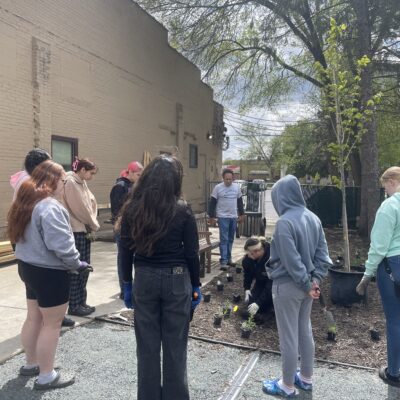
When Metro Blooms Environmental & Social Justice Manager Manny Vazquez called out, “Who wants to help me plant the tree?” two students immediately shouted “Me!” and ran over without hesitation.
That moment captured the spirit of the afternoon at Face to Face Academy: students taking ownership, working side-by-side withvolunteers, and helping shape a space they and future students will use and take care of for years to come.
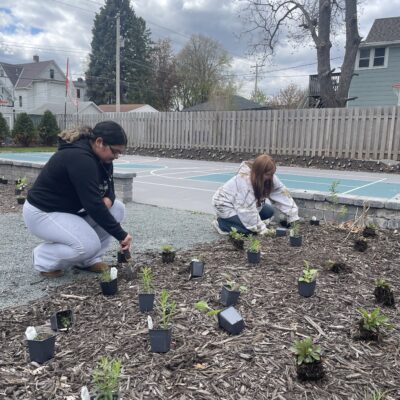
On a cloudy but mild Tuesday afternoon in early May, students, teachers, Metro Blooms staff, and volunteers gathered behind the school to plant nearly 600 native plants in Face to Face Academy’s newly redesigned outdoor space.
Music played in the background while people chatted and spread out across the garden beds tucked between gathering areas and recreation spaces. For many, it was the first time getting their hands in the dirt this spring — and Metro Blooms’ first large community planting of the season.
What emerged that day was more than a collection of gardens. It was the next chapter in Face to Face Academy’s years-long effort to create an outdoor space centered around belonging, learning, and student leadership.
Reimagining the Backyard
Face to Face Academy is a small public charter high school serving students in grades 9–12 on the East Side of St. Paul. Face to Face meets the needs of students who thrive in smaller classes, offering a curriculum designed to help them reconnect with their education.
Over the past five to seven years, the school has been transforming the lot behind its building into a vibrant outdoor gathering space. The space, once home to a boarded-up house, now includes a basketball court, raised garden beds for edible plants, and a small amphitheater-style seating area where classes can gather outside.
Alisa Hoven, Education Assistant and Garden Coordinator at Face to Face Academy, has helped guide the project from its early stages, working closely with students throughout the planning process. Students in the school’s garden and plant science classes have been especially involved in imagining what the space could become.
Designing a Space Students Could Shape
In fall 2024, Face to Face Academy partnered with landscape architecture firm HGA to create a vision board and professional renderings for the outdoor space. The designs helped students and staff see what was possible. Later, Sculpted Earth helped install the hardscaping and gathering areas that laid the foundation for the project.
From there, Face to Face reached out to Metro Blooms to collaborate on adding native plantings throughout the site, including a rain garden and new trees.
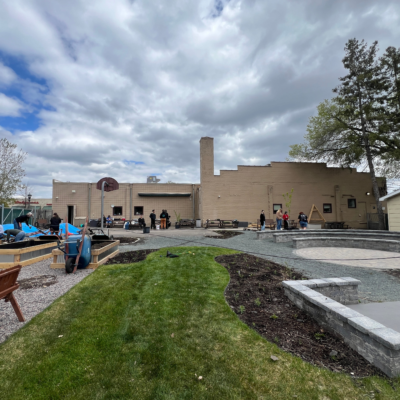 With funding support from the St. Paul Garden Club for plants and soil, support from the MN DNR ReLeaf program for trees, along with additional support from Ecolab for staff time and student stipends, Metro Blooms and Face to Face worked together to design and plant the gardens.
In March, Metro Blooms’ Community Relations team visited the school to facilitate a garden planning session. Students worked in small groups to envision the planting areas and select native species, considering pollinator value and seasonal blooms as well as practical questions like choosing durable plants near the recreation court that could tolerate foot traffic.
Metro Blooms Design+Build designer Nikolai Fjelstad De Santiago then transformed those ideas into planting plans, while Environmental & Social Justice Managers Makayla Freeman and Manny Vazquez coordinated the project overall.
“Having the students be involved in the planning gave them a sense of ownership during the planting,” Makayla and Manny reflected.
A Planting Day Full of Energy
Planting day finally arrived in early May. At first, laying out hundreds of plant plugs and sorting through last-minute substitutions felt overwhelming. But as teachers, students, and Ecolab and St. Paul Garden Club volunteers arrived, the project quickly took on a collaborative rhythm. People stepped in wherever help was needed — placing plants, digging holes, watering, hauling soil, and encouraging one another along the way.
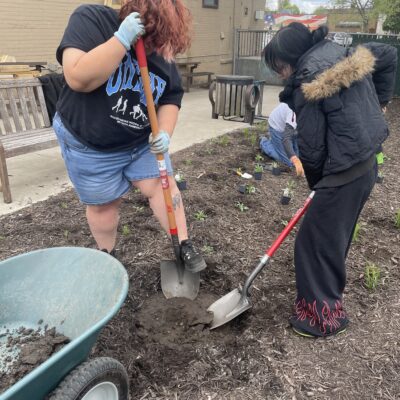 The students who participated received stipends for both the planning sessions and planting day, recognizing the value of their time, ideas, and labor.
A few students even stayed after the planting wrapped up, helping water the gardens and spending time in the transformed space. Later that same week, students and staff planted additional native plants and a serviceberry tree in a memorial corner dedicated to students who have passed away.
For Alisa, the project is about much more than landscaping.
She hopes the space gives students a sense of stewardship and peace — especially in an area of the city where access to green space can be limited. The gardens offer a place where students can find refuge, connect with nature, and feel that they are part of caring for something larger than themselves.
The timing of the planting also aligned perfectly with a school open house event shortly afterward, giving families and former students an opportunity to experience the new outdoor space firsthand.
“The students here every day get to see the evolution and help with micro-decisions,” Alisa shared. “Families and former grads are surprised by the transformation — it’s fun to see people’s imaginations open up to what is possible and what can be student-led.”
Makayla and Manny also reflected on the impact of seeing the plans finally come to life.
“It was really nice to see the culmination of the planning — and so many plants!” they shared. Over the course of just three hours, the group planted nearly 600 native plants together.
Growing Into the Future
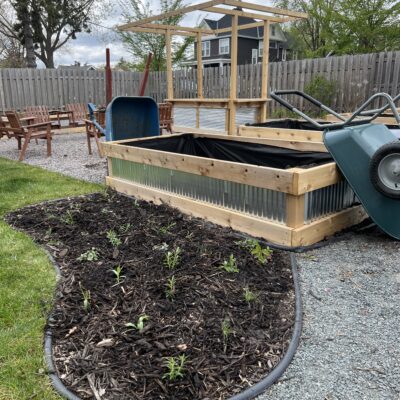 As the gardens mature, Face to Face Academy staff are excited about the possibilities ahead.
Alisa hopes more teachers will begin using the outdoor space for classes and that the native plantings can become part of the school’s science curriculum, giving students opportunities to observe plant life cycles, pollinators, and seasonal change firsthand.
She is also looking forward to expanding the edible garden spaces with students by growing vegetables and herbs in the raised beds. Eventually, she hopes the harvest can be shared with families during community harvest nights.
For Program Director Darius Husain, the transformation is already changing how students engage with school.
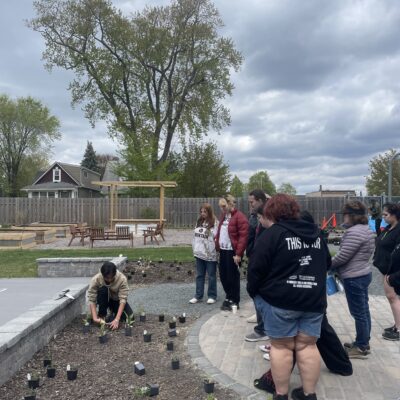 “When I go outside and see our work-based learning group, garden class, and fitness groups all engaging with the space, I can feel the elevated energy,” he shared. “That was the hope — to see kids engaged and taking ownership of the space and their education.”
The outdoor space offers students a place where learning feels active, collaborative, and connected to the real world.
And perhaps most importantly, the project shows what can happen when young people are trusted as leaders and collaborators in shaping their environment. Together, students, staff, volunteers, and community partners created something lasting — a space that will continue to grow alongside the students who care for it, season after season.
— by Megan Reich, Metro Blooms Communications + Education Co-Director